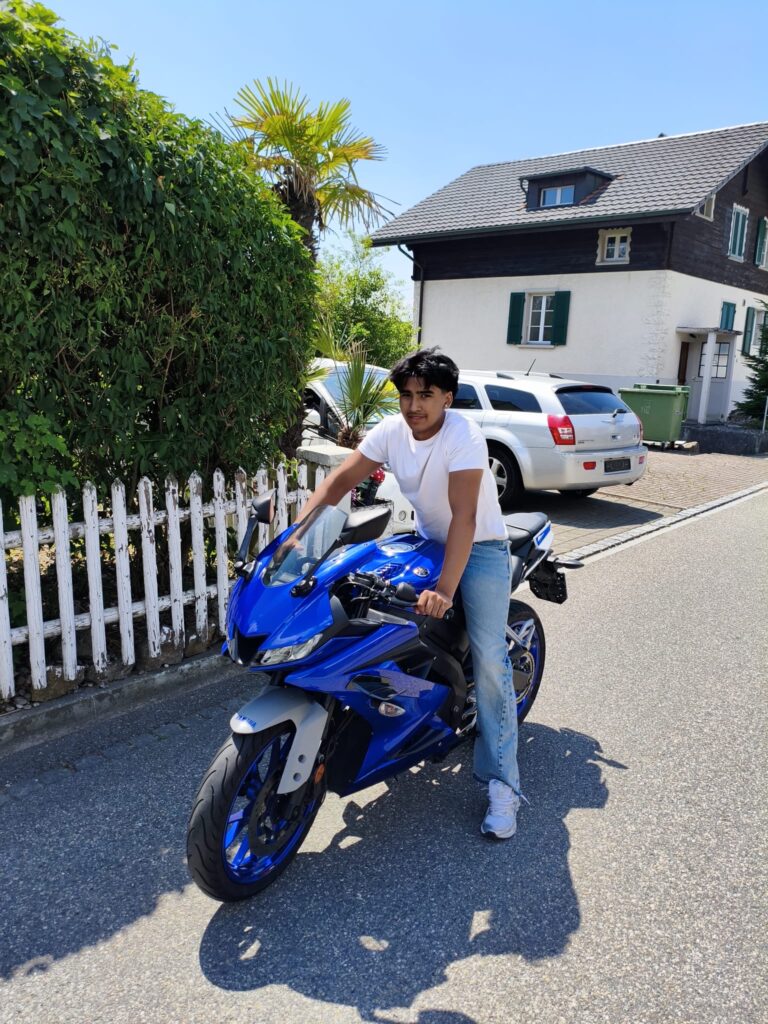
My wish is to have my own motorcycle.

Syon's dream of freedom becomes reality

Syon, 16, who lives in the canton of Bern and has cancer, had always had a dream: to own his own motorcycle.

For him, it wasn't simply a means of transport. It was a symbol of freedom, independence, and the future.

"I've always dreamed of riding a motorcycle and owning one. For me, it represents a piece of freedom."

A Wish Journey filled with emotion

Like every Make-A-Wish wish, the adventure began long before the big day.

Our volunteers Nicolas and Christoph met with Syon and his family to discover his world, his passions and what would make this wish truly unique.

Very quickly, a challenge arose: the motorcycle Syon dreamed of was a rare model. Determined to make this dream a reality down to the smallest detail, Christoph traveled to several regions of German-speaking Switzerland to see different models and find the one that perfectly matched Syon's expectations.

This preparation phase allowed anticipation, hope, and excitement surrounding the wish to grow. Each step of this quest was already part of the Wish Journey.

The big day

At the end of June, just a few weeks after obtaining his motorcycle license, Syon was simply planning to share a pleasant lunch with his family.

But a wonderful surprise awaited him.

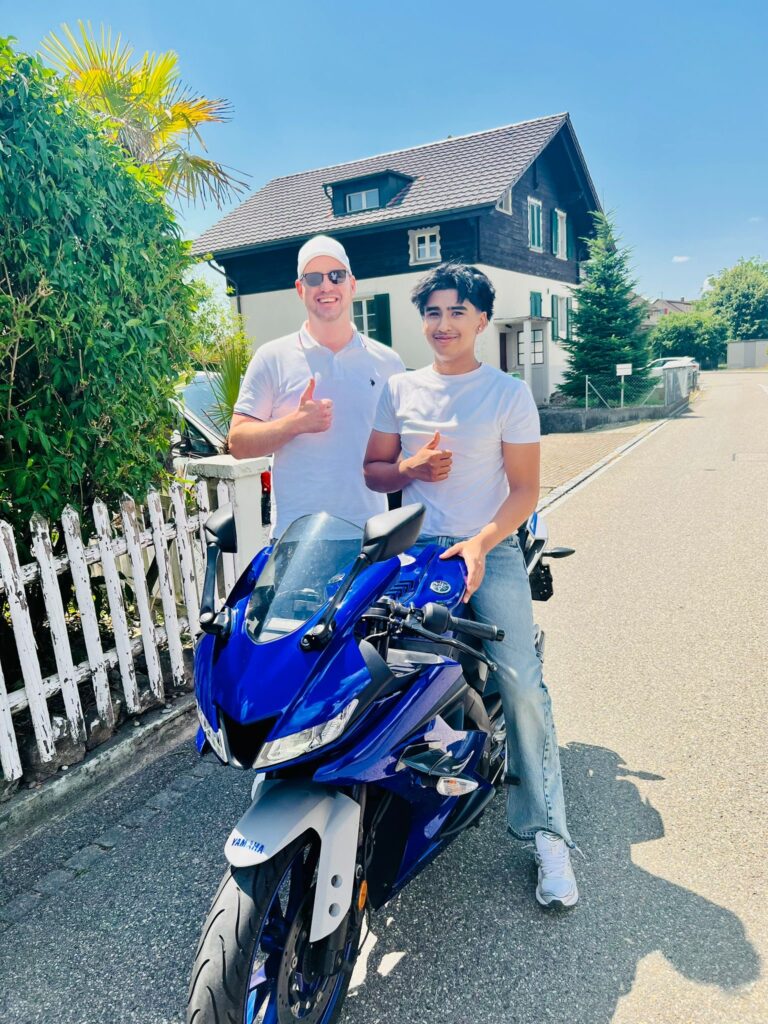
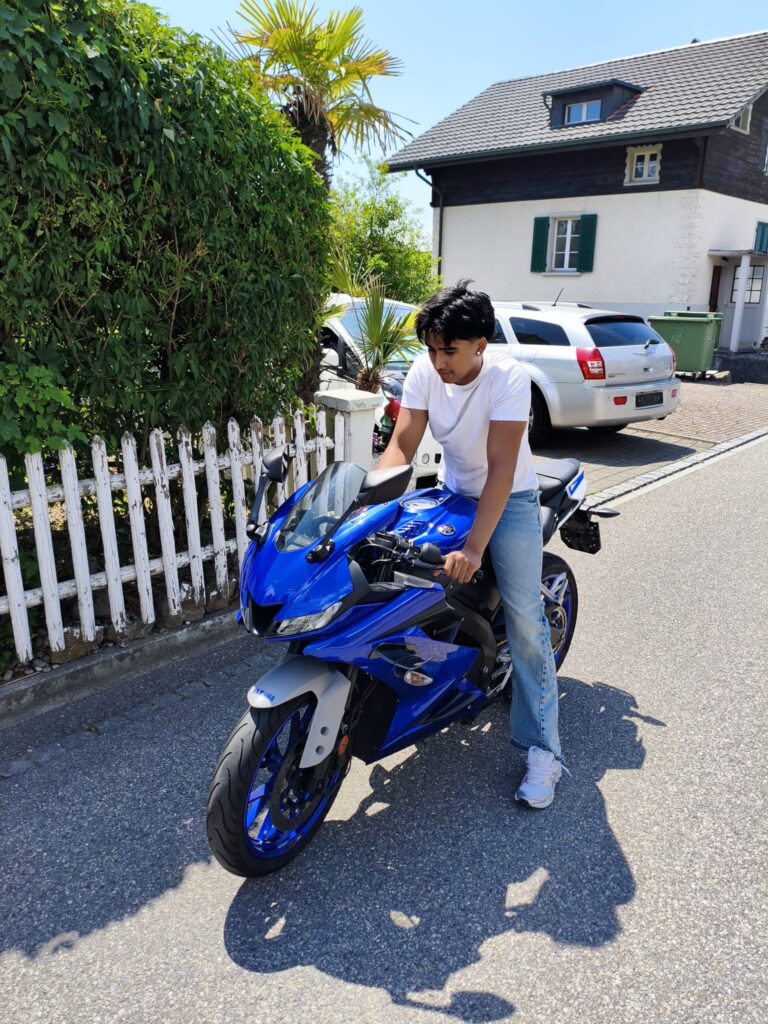
Outside was the motorcycle of his dreams: a superb blue Yamaha R125.

Surrounded by his loved ones, Syon received the keys to his new vehicle in a very emotional moment. A mechanic was also present to explain how the motorcycle worked and give him all the necessary advice for safe riding.

Throughout the day, Nicolas and Christoph had the privilege of immortalizing these precious moments, capturing smiles, looks of wonder, and emotions shared as a family.

A newfound freedom

Syon's emotion was immense.

"I'm so happy. I never even dared to dream that I could one day own my own motorcycle, let alone the one of my dreams. It's magnificent, exactly as I imagined it. I love riding it. It gives me so much independence and freedom."

Her mother also shared an unforgettable memory:

“From day one, Syon spent nearly five hours riding his new motorcycle. He couldn’t stop smiling. Seeing him so happy is an incredibly precious moment for our whole family. We are deeply grateful to Make-A-Wish for making this dream possible.”

Much more than a wish

At Make-A-Wish, a wish is never just about the moment it is granted.

The Wish Journey begins with the first encounters, is built through preparations and anticipation, and then transforms into a memory that continues to bring joy, strength, and hope long after the big day.

For Syon, this motorcycle represents much more than a dream come true: it embodies freedom, renewed confidence, and the possibility of continuing to look towards the future.

A huge thank you to our volunteers Nicolas et Christophwhose commitment, kindness and determination enabled Syon and his family to experience this magnificent adventure.
Every year in Switzerland, many children receive a diagnosis that changes their lives forever. The joy of childhood suddenly gives way to medical treatments and hospital nights.

A wish granted gives back this childhood stolen by illness. It brings light and joy, leaving a lasting imprint on the hearts of the entire family.

Make a wish come true with us, because hope changes everything.

Help a child

As with Syon

Support a child who simply dreams of experiencing something unique, escaping the daily grind and experiencing a moment of pure happiness. Behind every dream lies a need for recognition, escape, or hope.

Testimonial · Interview

"Hope is a decision."

An interview about courage, family, and inner strength

Carolin Oder

Mother of a Wish Kid — wish granted in 2017 · speaker and author
Interview by Michelle Schmocker (Make-A-Wish) · February 13, 2026 · translated from German

Carolin Oder is a speaker, mentor, and author with an inspiring message: even in the most difficult times, there is the strength to grow and rediscover the joy of life. Shaped by her own experience and the deep conviction that strength often arises where life tests us, she developed the "GENAUSO Principle"—seven paths to inner strength. Today, she supports those going through a crisis, helping them embrace it and emerge stronger. Her heart goes out to caregivers, often invisible yet so essential. In 2017, her eldest son's dearest wish came true thanks to Make-A-Wish Switzerland—a life-changing experience that continues to sustain her family today.

"Hope is not a feeling. Hope is a decision."

You are a speaker, mentor, author, podcaster and mother of two. What are you focusing your life on right now?

My life now revolves around two things: my professional fulfillment—which I consciously chose at the beginning of 2023—and my children. At 13 and 16, my boys still need me. And L.'s illness.1 This means I remain very present. It's normal, and it's right. He has become much more independent and makes his own decisions, but I continue to provide him with structure and guidance.

I'm trying to find a good balance. And at the same time, I make it very clear: if anything happens to her, then she will be my absolute priority. Everything else takes a back seat—including my professional development. And perhaps that's my truth today: these two aspects have the right to exist side by side—my role as a mother and my own life.

To what extent has working on your book changed your family's situation?

Much more than I would have thought possible. My family can clearly feel how good this newfound fulfillment is for me. I've become calmer, more serene. I live much more in the here and now, and much less in future scenarios often dictated by fear.

The effect is immense. My fears of loss have significantly diminished—and with them, the daily stress. I'm not the only one who feels this relief: my children and my husband do too.

With the younger brother, it was a long and difficult time. He felt that I devoted more time and energy to the older one. From this arose a very painful feeling: that of being, as the younger and healthy child, less visible. For over a year—he was eleven—I heard him say to me almost every night, "You love L. more than me." It tore me apart inside.

We sought support and guidance. I learned to look at things more consciously—not just to react, but to actively act to restore balance. I always believed I gave him enough love. But I understood one thing: feeling it isn't enough; you also have to make it visible and tangible.

It took a lot of energy. And honestly, for a long time, it didn't really work. It wasn't until I started to put myself more at the center again that things changed. With my own stability came more peace throughout the entire family system. Before, I would jump when the phone rang—fearing that something had happened. Now, that's no longer the case. And that relief—for all of us—is priceless.

Do you remember the moment your life changed forever with your son's illness?

Yes. Very clearly. That was the day of the diagnosis. For seven years, we simply held on. We reacted, we organized, we found solutions — but we never knew why all this was happening.

He was born in Germany, and doctors very early on looked for a genetic cause—without success. When he was fifteen months old, we emigrated to the United States. Today, I know that life—or the universe—led us to San Francisco. There, they discovered cervical vertebral instability—a chance discovery. A neurosurgeon stabilized it during four major operations. There, too, the search continued—again without success.

Back in Switzerland, at the Zurich Children's Hospital, the diagnosis came in 2017: Loeys-Dietz syndrome2And we were lucky—I'm very aware of that now. The geneticists knew exactly what to look for. Many parents aren't so lucky. Many families search for answers for years—some never find them. We got ours. In four weeks.

And that answer was hard to take: a potentially fatal connective tissue disease. A glimpse of a future we could never have imagined. And yet—in hindsight—it was precisely that diagnosis that saved her life.

Two years later, when L. had just turned nine, he suffered an aortic dissection.3Something that normally doesn't happen in a child of that age. We spent 32 days in the cardiac and vascular surgery intensive care unit at the University Hospital of Zurich. In two major operations, his aorta was replaced with prosthetic material.

Without the 2017 diagnosis, our son would not be with us today. This is a reality that still deeply affects me. Because it was precisely at that moment that we understood: this knowledge was not just a simple diagnosis—it was the reason why our child survived.

How did you find out about Make-A-Wish?

I was already familiar with the Make-A-Wish Foundation in the United States, through the children's hospital where we were being treated—probably thanks to a leaflet. After the diagnosis, one thing was immediately clear to me: L. had already been through so much—he deserved to have his dearest wish granted.

I asked him, "If you could wish for anything—really anything—what would it be?" And he replied, "I would like to meet Álvaro Soler."4“Honestly, I was completely overwhelmed—I didn’t even know him and I was like, ‘Couldn’t he have said Taylor Swift?’ (laughs) Then I listened to his music and realized, ‘Oh yeah, I know him, I’ve heard him on the radio.’ Make-A-Wish then made this meeting possible.”

For L., this moment was simply magical—but for us too, as a family. That feeling of being able, for a fleeting moment, to forget everything: the worries, the fear, the responsibilities. What you offer isn't just experiences. It's moments of lightness. Memories that last. And it's precisely for families of sick children that these moments are invaluable.

What prompted you to share your story publicly?

Because I broke myself in the process. In 2022, the collapse happened: caregiver burnout and post-traumatic stress disorder. For years, I held on, carried, organized, and was strong—for my child, for my family. And, in doing so, I completely ignored how it was doing to me.

I was always told, "You're so strong." And I ended up believing it myself—until the day I couldn't anymore. And that's precisely the problem: often, we're only noticed when we break down.

That's what I want to change. I want it to happen sooner. I want people—and especially caregivers—to be supported before they reach their limits. To that end, I seize every opportunity offered to me in the German-speaking world.

When I started sharing my story, I realized how many people identified with it. That feeling of the ground shifting beneath your feet, the constant burden, the uncertainty—so many people know this. And if I can reach even one person who takes a step back and seeks help so they don't get lost, then every minute of my work is worthwhile.

What would you have liked to have back then?

To be seen. Truly seen. Not just as "the strong mother," but as a person. I wish someone had asked not just, "How is your child?" but also, "And how are you—really?" And not just once. Not just during acute crises. But also in the quiet moments, in between, when everything seems fine and peaceful.

I wish I'd had someone to guide me—a mentor, a framework, tools I only learned to give myself years later: breathing exercises, mindfulness, stress management, mental stability. Things that don't change the situation itself, but the way you experience it.

And I would have loved a community. People who understand without me constantly having to explain. Who know what these waves are like: it's okay—and then it tips again. That's precisely what I want to convey today as a mentor.

How is your son today?

Right now, he's doing well. And that's something I'm very consciously aware of—something I no longer take for granted. What touches me most is his inner strength.

Recently, on the way to the children's hospital, he naturally started talking about his future. And he said, "I think I'm a good person." I asked him why. And he replied: because he's kind, considerate of others, not stupid—and because, later on, he'll take good care of himself.

At that moment, I understood: he's thinking about his future—without fear. He didn't say a word about the illness. That deeply moved me. We tried, very early on, to instill in him this forward-looking outlook—this confidence in life. And for him to express it today, at 16, of his own accord, was a gift.

His psychiatrist also confirms that he doesn't have a fear of death—even though he knows exactly what it is. The fears, and also the traumas, lie with us, the parents. In recent months, he has become incredibly independent. At the same time, the medical challenges remain: major surgery on his lower spine is being considered. His carotid artery is changing in a worrying way. And with each examination, we hope that nothing new will be discovered.

Physically, he's different from other kids his age—precisely at an age when appearance matters so much. It's not always easy for him. But overall, we're in a good period right now. My husband and I still make a good team—that's no small feat either. Eighty percent of couples under constant strain don't survive it. And the relationship between the two brothers is, right now, wonderful. It's moments like these that sustain us.

Is there anything you would like to pass on to other parents?

I have no advice to give—these parents are already giving everything, anyway. But I would like to remind them of one thing: hope is essential. Hope is not a feeling. Hope is a decision.

In these situations, hope doesn't come easily. It's not always there. You don't wake up every morning feeling it automatically. There are days when it's very faint. And days when it's almost imperceptible. But it's precisely then that I make this decision, fully aware of it.

I choose to keep hoping—even without knowing how it will end. Even when I'm afraid. Even when I have no control over what comes next. For me, hoping doesn't mean everything will be alright. Hoping means believing I'll be able to face whatever comes my way. That we'll find a way—one way or another.

And at the same time, there's something absolutely crucial that goes with it for me: self-care. I like to compare it to the image of a water bottle. Imagine you have a water bottle. You drink from it yourself—but you're also constantly giving back from its contents: love, strength, support, responsibilities, decisions. And the problem is that many of us just give, without even noticing that our bottle is emptying. But when your bottle is empty, you can no longer take care of yourself or the person you love.

That's precisely why it's up to you to fill this bottle, again and again. With simple things: a walk, a conversation, a moment for yourself. But also with structure and tools. Not because it's a nice "extra"—but because it's necessary. I myself didn't understand this for far too long. And then one day, the message hit me. That's why it's so important to me now to pass it on.

For me, hope and self-care go hand in hand. And I make this decision every day, again and again: for myself, for my child, for my family—and perhaps for others as well. Because I know how precious it is when someone, in dark times, offers a glimmer of hope. Perhaps that's exactly what I want to be: a bearer of hope.

Notes

1 The boy's first name has been shortened by the editorial staff.

2 Loeys-Dietz syndrome (LDS) : a rare genetic disease of the connective tissue (1 case per 100,000) that affects the entire body, but primarily affects the blood vessels. The aorta, in particular, can dilate or rupture — which, without treatment, can be fatal within days.

3 Aortic dissection : a tear in the inner wall of the aorta, which causes a potentially life-threatening acute situation and requires immediate medical attention.

4 Alvaro Soler is a German-Spanish singer-songwriter who achieved international fame with his summery pop music. He reached stardom in 2015 with the hit "El mismo sol", followed by other successes like "Sofia".